

The moment of seat selection
For performing arts venues with reserved seating, seat selection is one of the most consequential stages in the whole journey. It's also one of the most commonly mishandled.
The problem is uncertainty. A customer looking at a seating plan, for a venue they've never visited or even one they have, often can't tell with confidence whether a particular seat will give them a good view of the stage. That uncertainty breeds hesitation. Some people resolve it by calling the box office. Many more quietly close the tab.
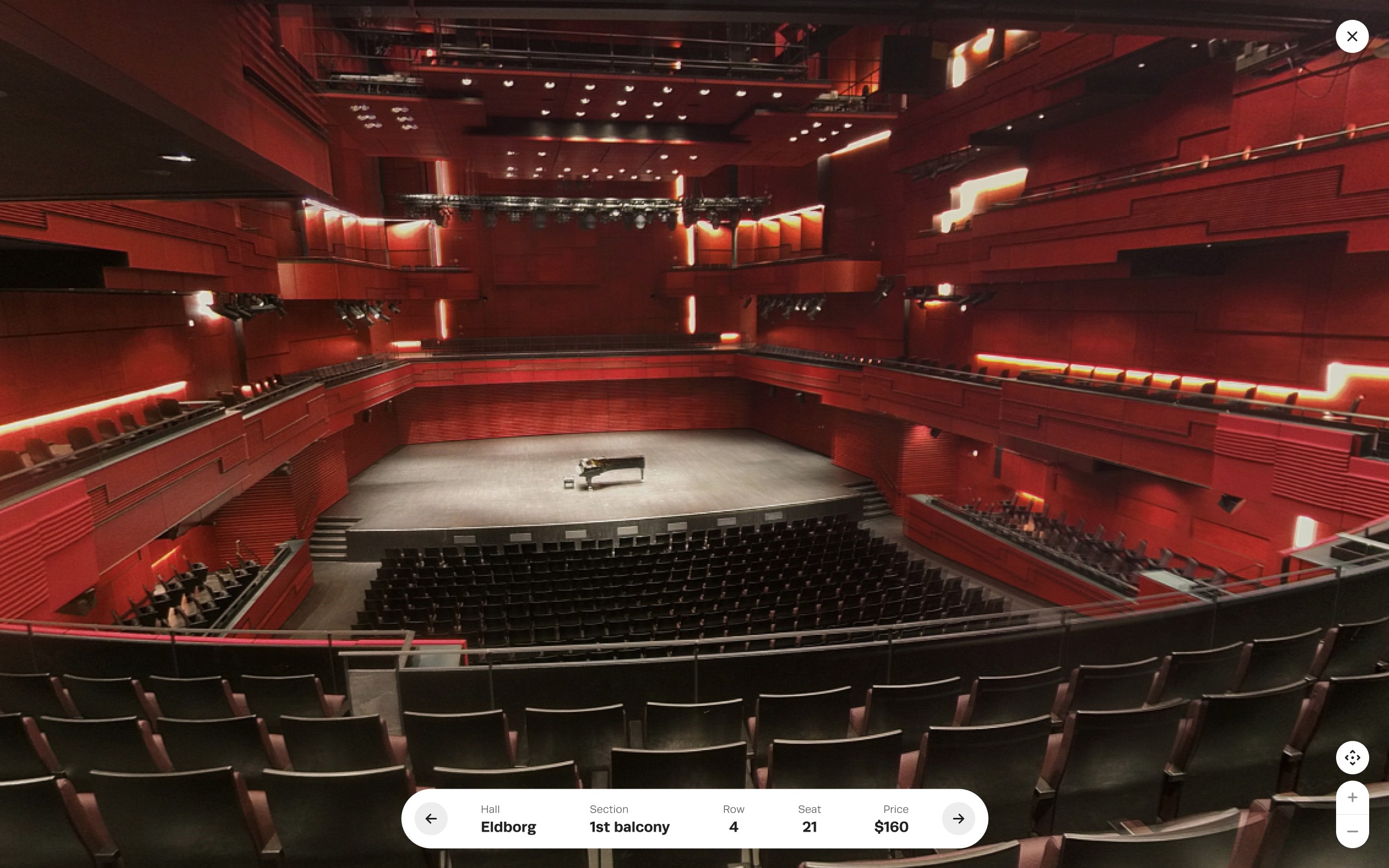
A 360-degree view from seat, built directly into the buying flow, removes that uncertainty at the exact moment it matters. Before they commit, before they pay, customers see precisely what their chosen seat looks like from that position. For venues with elaborate layouts, multiple balconies or unusual sightlines, this is one of the most direct ways to build confidence at the point of purchase. Confidence is what drives completed transactions.
A checkout that slows people down
Your customers book flights, restaurant tables and hotels through buying flows optimised obsessively for speed and simplicity. They arrive at your checkout with the same expectations, and when the experience doesn't match, they feel it.
The friction points worth addressing, roughly in order of impact:
Mobile experience. A checkout that works on desktop but becomes clunky on a phone is losing an increasingly significant share of any venue's audience. This is the one that costs most.
Number of steps. Every additional screen between selection and confirmation is another opportunity to lose someone.
Page load speed. Slow responses at checkout read as unreliability, particularly on mobile connections.
Forms that ask for what could be automated. Address autocomplete is a small example with a measurable effect. Asking someone to type their full address manually when their browser already knows it is friction that serves nobody.
Small obstacles compound across a checkout journey, and the cumulative effect is abandonment.
Missing the revenue that's right there
The point of purchase is the highest-attention moment in your customer's relationship with your venue. They're focused, they're engaged, and their payment details are already out. It's the natural moment to surface other things they might want.
Cross-show promotions at checkout, highlighting another production in the current season, work because the customer is already in a buying mindset. Membership offers presented mid-transaction convert well because the customer is already demonstrating they value what you do. Product upsells, whether that's a programme, a pre-show dinner or a drinks package, can be offered as a dedicated step in the buying flow with timed availability and stock controls, so you only show options that are actually available.
Post-purchase is another underused window. Customers can be offered add-ons from their receipt page up to a custom cutoff time, which is useful for food and beverage where you need to manage preparation, or for merchandise with limited availability. Personalised event recommendations on the receipt page, based on what they've just bought, extend the conversation beyond a single transaction.
The point is a buying flow designed to present the right options at the right moment. That's a system design question, not a marketing one.
Self-service, or the lack of it
A significant source of friction comes after the purchase, not during it. When customers can't manage their own bookings online, whether that's exchanging tickets, updating seats, forwarding a ticket to a friend or requesting a refund, they contact the box office. That's a cost to your team and an inconvenience to the customer.
Self-service ticket exchange, refund requests, ticket forwarding and digital wallet delivery all reduce box office contact volume while improving the experience for customers. The person who can sort out a date change themselves at 10pm on a Sunday is a happier customer than the one who waits until Monday morning to call.
For venues where cancellations happen, self-service refunds with a built-in donation option give customers a way to support the venue even when they can't attend. It's a small but meaningful conversion of a potential revenue loss into goodwill and partial recovery.
High-demand events, where the buying journey breaks down entirely
For most performances, the buying journey is a steady, manageable flow. For high-demand shows, it can become a crisis. A website that struggles under sudden traffic, or a buying flow that slows to a crawl when hundreds of people hit it simultaneously, creates exactly the wrong impression at exactly the wrong moment.
Queue management, holding customers in a fair and orderly virtual waiting room when demand spikes, protects both the buying experience and your website's stability. Tixly's integration with Queue-it handles this, so your highest-demand on-sales don't turn into a scramble that damages trust in your ticketing.
This matters beyond the immediate transaction. A customer who had a frustrating experience buying tickets for a popular show will think twice before going through the same process again. A customer who waited their turn in a clear, well-managed queue has a very different memory of it.
The experience before they even start buying
One friction point that's easy to overlook is the journey from your website into the buying flow itself. If customers have to navigate multiple pages to find what they're looking for, or if the transition from your venue's site into the ticketing platform feels abrupt and unbranded, trust erodes before a single ticket is selected.
A buying flow carrying your venue's visual identity, meaning colours, fonts and tone, creates continuity. It signals that the transaction is happening with your venue, not with an anonymous third-party platform. For venues with multiple spaces or brands, presenting a distinct buying experience for each one means every customer sees something that feels right for the event they're attending.
Payment choice plays a role here too. Offering the methods your customers actually use, whether that's PayPal, Klarna, Apple Pay, Google Pay, Vipps or standard card payments, removes a final point of friction for customers who've made it all the way through and then find their preferred option isn't there.
Where to start
The ticket buying journey has more friction points than most venues realise, and few can tackle all of them at once. If you're looking for a starting point, the checkout itself is usually where the largest recoverable losses sit, particularly on mobile. Seat selection confidence comes next for venues with complex layouts.
To talk through how your venue's buying journey is performing, get in touch with us today.